
The flagship program
The Adulting Finances Program
Learn personal finance. Build a plan you understand.
The money skills your career assumes you already have, taught in the order you need them. Work at your own pace, with the Plan Builder included. You start from where you actually are and finish with a written Financial Plan you can explain line by line, then keep it current as life changes.
Not ready? Try a full sample lesson free or create a free account and take Module 1.
- modules in five stages
- 13modules in five stages
- lessons, each with an action
- 67lessons, each with an action
- Decision Labs for major choices
- 5Decision Labs for major choices
- written Financial Plan, yours to keep
- 1written Financial Plan, yours to keep
What you finish with
Not a certificate. A working plan for your money.
Each module builds one working part of your finances, and the plan doesn’t stop at the last lesson: Decision Labs, the Life Event Hub and scheduled reviews keep it current.
A money map and baseline
Net worth, cash flow and real spending, from your own statements.
A cash-flow system
Accounts that each have a job, sinking funds and a payday routine you set up once.
A debt and credit plan
A payoff order you chose and can explain, and a credit profile you’ve checked and protected.
Your benefits, understood
Your match, health plan and paycheck, read line by line and written into your plan.
An investment policy
Which accounts, what mix, how you’ll rebalance and what you’ll do in a downturn, in your own words.
Decisions on the record
5 Decision Labs (debt payoff order, health plan, job offer, vehicle, rent-or-buy) put the options side by side and save your choice, your reason and what would change your mind.
A plan that keeps up
25 life events, from a first job to a move, each reopen the parts of your plan they touch. A review schedule shows what’s due.
Your Financial Plan
A written, printable plan with dated actions and the review triggers you set.
How every lesson works
From the idea to your own decision, in one sitting.
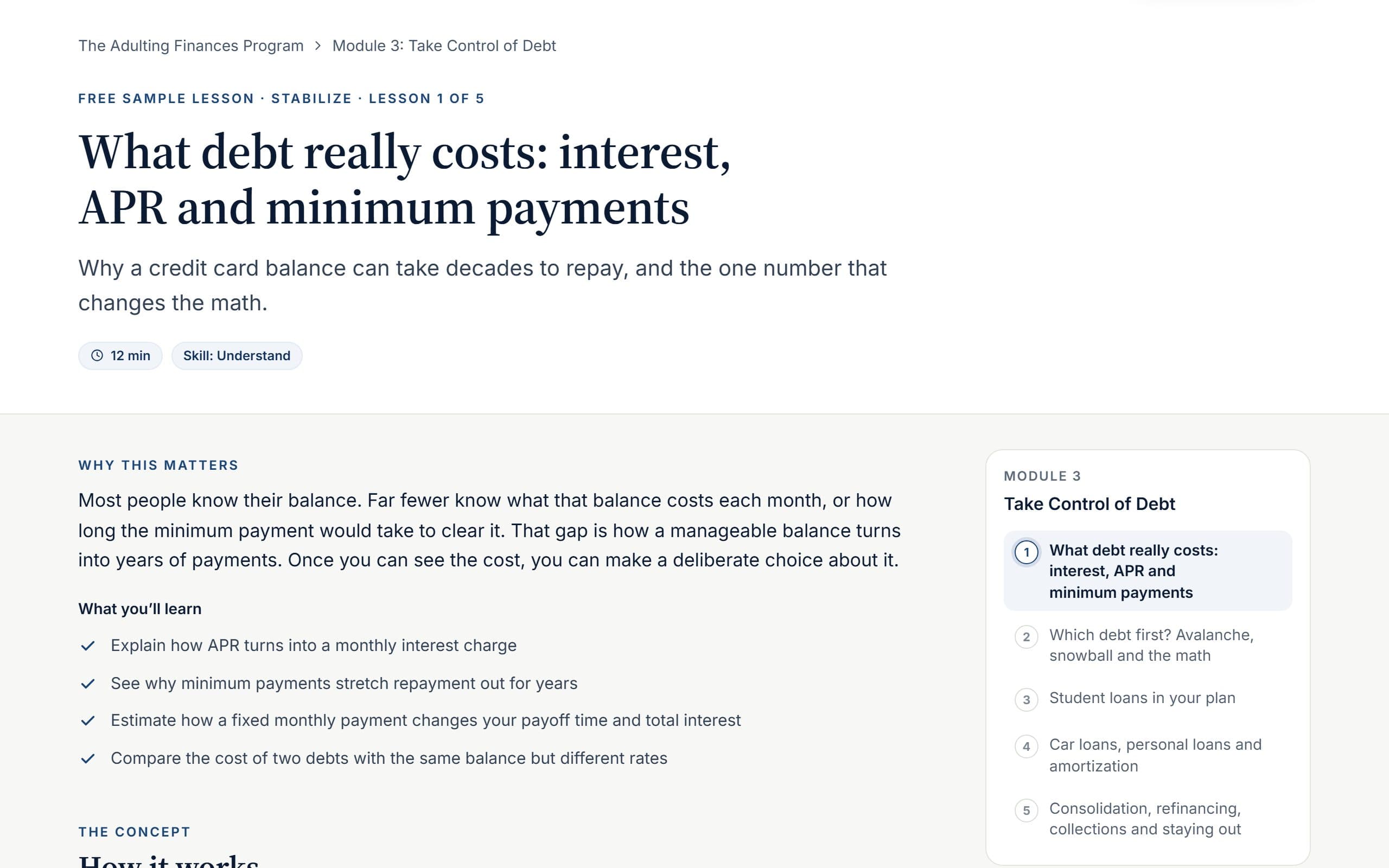
Every lesson follows the same five steps. Below is a real one: the free sample lesson from Module 3.
- 1
Learn the concept
Short, plain-English lessons with the why before the how.
- 2
See it worked through
One of the example households works it through, with the math shown.
- 3
Check your judgment
Scenario questions with feedback, not memorization quizzes.
- 4
Apply it to your numbers
One specific action, on your own numbers.
- 5
Save it to your plan
Most lessons save their result to a section of your Financial Plan.
The curriculum
Built in the order your money actually works.
13 modules across five stages. Learn the terms, steady your cash and debt, get more from your income and benefits, invest with a framework, then make the big decisions on purpose.
Understand
Module 1 · 6 lessonsYour Financial BaselineKnow exactly where you stand before deciding anything.
You’ll be able to
- Calculate your net worth and your monthly cash flow
- See where your spending actually goes, including the costs that don’t show up every month
- Turn vague wishes into goals with a dollar amount, a date and a reason
- Learn the Financial Order of Operations and find the step you’re on
Lessons
- 1. How your financial life fits together10 min
- 2. Start here: what we know, what we need and what is changing10 min
- 3. Your money map: net worth and cash flow12 min
- 4. Where your money actually goes14 min
- 5. Goals that pull you forward12 min
- 6. The Financial Order of Operations18 min
Stabilize
Module 2 · 7 lessonsControl Your Cash FlowBuild a money system that runs on payday, not willpower.
You’ll be able to
- Set up accounts that separate bills, everyday spending and savings
- Choose a spending plan style that fits how you think about money
- Turn irregular and annual costs into predictable monthly set-asides
- Size your emergency fund, decide where it lives and automate how it grows
Lessons
- 1. Banking that works for you12 min
- 2. How to evaluate any bank, app or brokerage12 min
- 3. A spending plan you’ll actually keep14 min
- 4. The Stabilize sequence: when more goes out than comes in14 min
- 5. Sinking funds: make irregular costs boring11 min
- 6. Automate your money on payday13 min
- 7. Your emergency fund: how much and where13 min
Module 3 · 5 lessonsTake Control of DebtSee what debt really costs, then pay it down in an order that makes sense.
You’ll be able to
- Calculate what a balance costs you each month and over its life
- Rank your debts and choose between avalanche and snowball on purpose
- Fit student loans and car loans into the rest of your plan
- Know when consolidation or refinancing helps, and when it only moves the problem
Lessons
- 1. What debt really costs: interest, APR and minimum paymentsFree sample12 min
- 2. Which debt first? Avalanche, snowball and the math14 min
- 3. Student loans in your plan15 min
- 4. Car loans, personal loans and amortization13 min
- 5. Consolidation, refinancing, collections and staying out15 min
Module 4 · 4 lessonsMaster Your CreditUnderstand the record lenders see, keep it accurate and make it work for you.
You’ll be able to
- Read a credit report and explain what moves a credit score
- Review your reports section by section and dispute errors
- Compare credit cards on the criteria that matter for how you use them
- Freeze your credit, respond to identity theft and prepare for a major loan application
Lessons
- 1. Credit reports, scores and what moves them13 min
- 2. Review your reports and fix errors14 min
- 3. Using and comparing credit cards13 min
- 4. Freezes, fraud and building credit for big purchases15 min
Module 5 · 4 lessonsProtect What You’re BuildingMake sure one bad event can’t undo years of progress.
You’ll be able to
- Decide which risks to insure and which to cover yourself
- Read a health plan and estimate what it will cost you in a normal year and a bad one
- Know when disability and life insurance matter, and how much of each to think about
- Check your renters, auto and liability coverage against what you could actually lose
- Name a beneficiary on every account that allows one
Lessons
- 1. Risk, insurance and deductibles11 min
- 2. Health insurance, decoded14 min
- 3. Protecting your income: disability and life insurance14 min
- 4. Renters, auto, liability and beneficiaries15 min
Optimize
Module 6 · 7 lessonsIncome, Career & BenefitsYour salary is only part of your pay. Learn to use all of it.
You’ll be able to
- Read every line of a paycheck and explain where each dollar goes
- Compare job offers on total compensation, not just salary
- Understand your retirement plan, its match and its vesting schedule
- Choose between Roth and traditional contributions on purpose
- Decide whether an HSA or FSA fits your situation
- Understand how RSUs, ESPPs and stock options pay you, and the risks they carry
Lessons
- 1. Read your paycheck12 min
- 2. Total compensation and job offers15 min
- 3. Your workplace retirement plan16 min
- 4. Capture your full employer match13 min
- 5. Roth or traditional?14 min
- 6. HSAs and FSAs14 min
- 7. RSUs, ESPPs and stock options16 min
Module 7 · 3 lessonsTax-Aware Money DecisionsUnderstand how taxes shape your paycheck, accounts and investments.
You’ll be able to
- Tell your marginal tax rate from your effective rate, and use each for the right decision
- Keep your paycheck withholding on track and avoid surprise bills
- Handle 1099 and side income without scrambling in April
- Understand how interest, dividends and capital gains are taxed
Lessons
- 1. How income tax actually works13 min
- 2. Withholding, W-2s and 1099 income13 min
- 3. Taxes on investments13 min
Invest
Module 8 · 5 lessonsInvesting FoundationsLearn how investing works before deciding what to own.
You’ll be able to
- Decide which money belongs in savings and which can be invested, based on when you’ll need it
- Explain risk, return, volatility and drawdowns, and measure a decline in dollars
- See how contributions, time and growth work together, with returns treated as assumptions
- Know what stocks, bonds, cash and funds are, and how to read what a fund holds and costs
Lessons
- 1. Saving vs. investing, and why inflation matters11 min
- 2. Risk, return and volatility12 min
- 3. Compounding and time11 min
- 4. Stocks, bonds and cash12 min
- 5. Mutual funds, ETFs and index funds13 min
Module 9 · 3 lessonsAccounts: Where Your Investments LiveChoose the right account before you choose what goes in it.
You’ll be able to
- Explain the difference between an account and the investments inside it
- Compare workplace plans, IRAs, HSAs and taxable brokerage accounts on taxes, limits and access
- Check your eligibility for Roth and traditional IRA contributions and deductions
- Evaluate an account provider on cost, fund selection and service
- Decide which account your next dollar goes to, and explain why
Lessons
- 1. The account vs. what’s inside it11 min
- 2. IRAs and taxable brokerage accounts14 min
- 3. Where your next dollar goes13 min
Module 10 · 6 lessonsBuild Your PortfolioTurn investing knowledge into a portfolio framework you understand.
You’ll be able to
- Choose an asset allocation on purpose, and connect it to a goal and a time horizon
- Tell real diversification from owning a lot of things, and spot concentration risk
- Weigh risk tolerance against risk capacity, and handle a mismatch between them
- Evaluate target-date and broad index approaches on cost, holdings and structure
- Put a dollar figure on investment fees and keep them under control
- Write an investment policy you can follow in a downturn
Lessons
- 1. Asset allocation: your biggest investment decision13 min
- 2. Diversification and concentration risk13 min
- 3. Risk tolerance, risk capacity and time horizon12 min
- 4. Target-date funds and broad index portfolios13 min
- 5. Fees: the return you control12 min
- 6. Write your investment policy15 min
Module 11 · 4 lessonsInvest With DisciplineThe behavior that makes a good portfolio actually work.
You’ll be able to
- Automate contributions and set a rebalancing rule you’ll follow
- Compare dollar-cost averaging and lump-sum investing honestly
- Recognize loss aversion, recency bias, overconfidence and herd behavior in your own decisions
- Understand valuation, interest rates, sequence-of-returns risk and factors at a high level
- Monitor your investments on a schedule and know how to evaluate a financial professional
Lessons
- 1. Automate, dollar-cost average and rebalance14 min
- 2. Panic, FOMO and chasing returns13 min
- 3. Beyond the basics15 min
- 4. Monitor without obsessing, and when to get help13 min
Build
Module 12 · 8 lessonsMajor Life DecisionsModel big decisions before you commit to them.
You’ll be able to
- Compare your current state, an alternative and the financial consequences of each for any big decision
- Buy and finance a car, rent well, and judge rent vs. buy on total cost and time horizon
- Prepare to buy a home with a down payment, reserves and a housing cost your plan can carry
- Weigh graduate school, job changes and relocation on their full costs and payback
- Combine finances with a partner, plan for children and manage side income and its taxes
Lessons
- 1. A framework for any big money decision14 min
- 2. Buying and financing a car16 min
- 3. Renting well, and rent vs. buy17 min
- 4. Preparing to buy a home17 min
- 5. Grad school, job changes and relocating16 min
- 6. Partners, marriage and family16 min
- 7. Running money together: roles, thresholds and two benefit packages13 min
- 8. Side income and self-employment16 min
Module 13 · 5 lessonsYour Financial PlanBring it all together into a plan you can follow and maintain.
You’ll be able to
- Rank competing goals and split your monthly surplus across them with the tradeoffs written down
- Complete every section of your Financial Plan and turn it into dated actions
- Stress-test your plan against job loss, a raise, a windfall, rate changes and a big purchase
- Set up monthly, quarterly and annual reviews that keep the plan working
Lessons
- 1. Sequence competing goals13 min
- 2. Assemble your Financial Plan15 min
- 3. Stress-test your plan13 min
- 4. The monthly check-in, step by step10 min
- 5. Your review system and what comes next12 min
An example plan
Here’s what the Plan Builder makes of one household’s numbers.
Maya is one of the example households the lessons follow, not a real person. Twenty-six, first salaried job at a mid-sized private employer, renting alone, carrying undergraduate loans. The card shows what the Plan Builder produced from her numbers, with the same calculations it runs on yours.
Decisions that are still hers to make
- She can fund the match or attack the loans faster, not both at full speed
- Her cheapest health plan is the one that would hurt most in a bad year
What’s in her Financial Plan
- Financial baseline
- Net-worth snapshot
- Cash-flow system
- Emergency reserve
- Debt strategy
- Credit checklist
- Protection review
- Benefits review
- Retirement contribution plan
- Tax notes
- Investment framework
- Saved decisions
- Goal hierarchy
- Major financial priorities
- Action plan
- Review schedule
Maya’s plan
Fictional exampleWhat we know
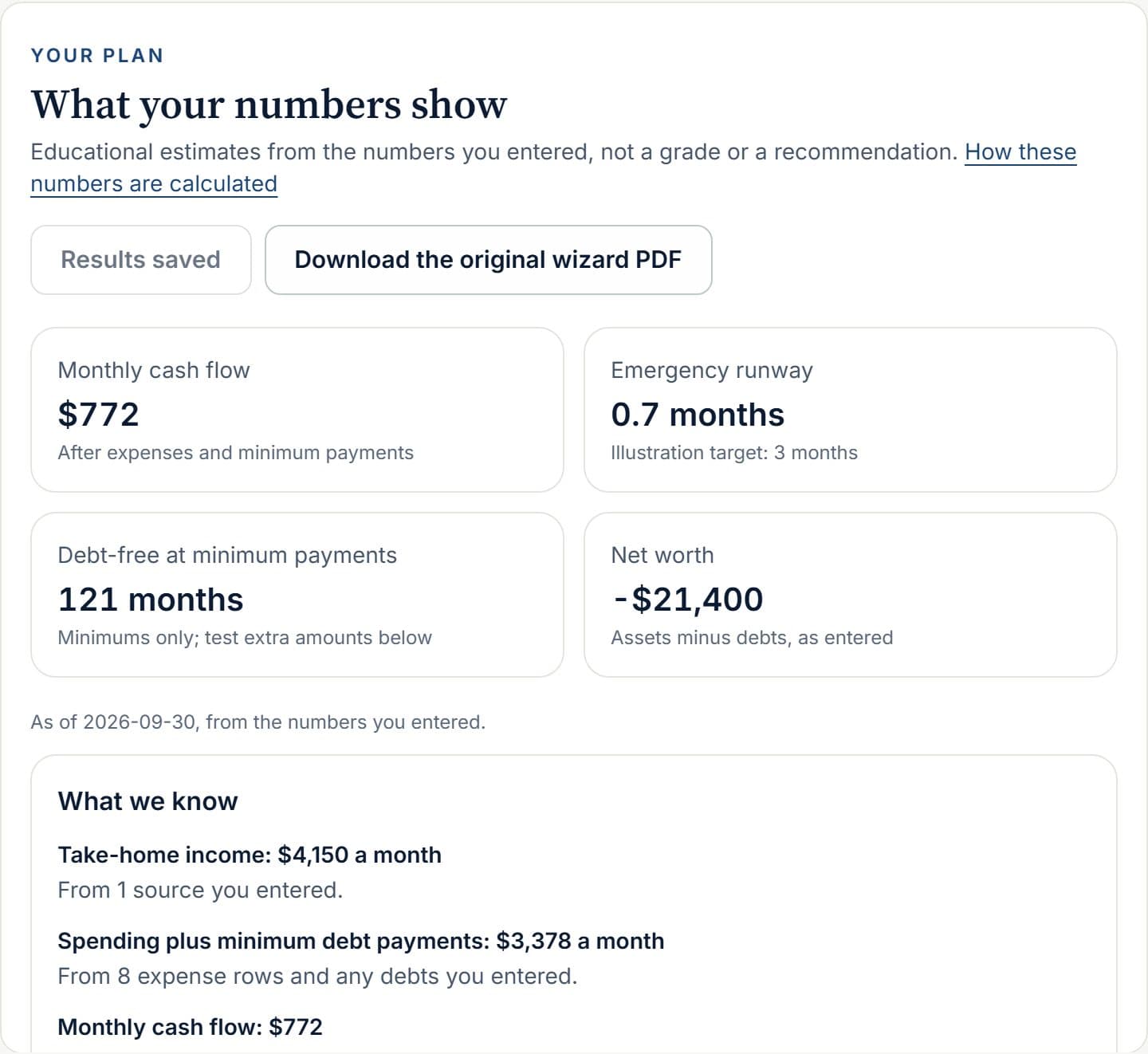
- Take-home income: $4,150 a month
- Spending plus minimum debt payments: $3,378 a month
- Monthly cash flow: $772
- Cash flow
- $772/mo
- Runway
- 0.7 mo
- Debt-free at minimums
- 121 mo
Ways to use the $772 left each month
- Weighted to buffer0.8 mo runway · 55 mo to debt-free
- Weighted to debt0.7 mo runway · 34 mo to debt-free
- Mixed0.8 mo runway · 55 mo to debt-free
- Weighted to goals0.8 mo runway · 71 mo to debt-free
The Plan Builder lays them out. Choosing is up to you.
Worth a closer look
- Cash covers 0.7 months
- How the payoff timeline is modelled
- Reviewing on a schedule
Who teaches it
Who you’ll be learning from.

Founder
Ryan Loveless, MS Finance
Founder, Adulting Finances · Personal Finance Education
Education and credentials
- Master of Science in Finance
- Investment Foundations Certificate, CFA Institute
- Beta Gamma Sigma honor society member
Areas of study
Investment management · Portfolio theory · Derivatives · Quantitative methods · Financial modeling · Scenario analysis
What’s included
Everything you need to finish, in one price.
No second paywall inside a lesson, and nothing else to buy to complete your plan.
- All 13 modules and 67 lessons, self-paced
- The Plan Builder, included: cash flow, runway, debt payoff order and scenarios
- Your Financial Plan workspace, saved and printable
- 17 interactive tools and calculators
- Progress tracking and a next-action dashboard
- One-on-one help understanding your Plan Builder results and using the program
- Occasional group Q&A sessions on the course topics
What happens after you enroll
- 1Create your account, then payCheckout is by Stripe. Your account comes first, so access is attached to it.
- 2Answer a few questionsA short start: where you are, what’s changing, and whether you’re behind on a payment. You can skip any question. You finish with one next step.
- 3Work at your paceLessons, tools and your plan save as you go. Sign out whenever you like; the dashboard shows what’s next when you return.
- 4Ask when you’re stuckOne-on-one help covers what your Plan Builder results mean and how they were calculated, and how to use the lessons, tools and your plan. Bring questions about the course topics to the group Q&A sessions.
Price and terms
One payment. No subscription.
The Program
The full curriculum with the Plan Builder included.
$1,999one-time
- One payment. No subscription and no renewal.
- Access for as long as the program is offered, including updates.
- Refunds: Full refund within 14 days of purchase if you’ve completed less than a quarter of the lessons.
- Secure checkout by Stripe. You’ll create an account first so your access is saved.
The full terms, including refunds, are in the Terms of Use.
Is it a fit?
Right for you, or not yet?
A good fit if
- You’re early in your career, or starting over, and want the whole system in order
- You have income and want to decide where each dollar goes, with reasons
- You want to understand investing without being sold a product
- You’ll put in a couple of hours a week and act on what you learn
Not the right fit if
- You want stock picks, trading signals or get-rich-quick strategies
- You need personalized investment, tax or legal advice for a complex situation
- You’re in a financial crisis today: start with a nonprofit credit counselor or the free resources in our library
- You’d have to borrow to pay for it: the free lessons and the checklist are a better place to start
Questions
Before you enroll.
How is this different from free content?
Free content answers questions one at a time. This program teaches the whole system in order, has you apply each lesson to your own numbers, and ends with a written plan you keep and keep using. The free library stays free and is a good place to start.
I’m new to all of this. Where do I start?
Module 1 assumes nothing. Every term is defined the first time it appears, and the free sample lesson shows exactly how a lesson reads. A free account opens all of Module 1, so you can see whether it suits you before you pay.
I already invest. Is this too basic?
The investing modules connect what you already hold to the rest of your plan: your match and benefits, the cash you’ll need soon, your debt, and how much risk you can actually carry. Move quickly through what you know; the plan still needs your numbers.
I have debt, or a family. Is it still for me?
Yes. Paying down debt, protecting a household and planning with a partner are all covered, and the fictional households in the examples include people in those situations. If paying for the program would mean borrowing, don’t. Start with the free lessons and the checklist.
Will you tell me what to invest in?
No. It’s financial education. Adulting Finances isn’t a registered investment adviser, and the program doesn’t recommend specific securities, funds or financial products. You learn how to evaluate your own options, and you make and write down your own decisions.
More questions, like how long it takes, refunds and the help that comes with it: read the full FAQ.
Your money already has a system. Make it one you chose.
Financial education only. Adulting Finances is not a registered investment adviser and doesn’t provide individualized investment, tax or legal advice. Examples are hypothetical.
Have a question before you enroll? Contact us
Existing material
Investment techniques and technical analysis
Ryan’s earlier technical-analysis material, created under RyLove Quantitative Statistics, is separate from this program and isn’t a next step for most learners. Technical analysis and backtests have real limits, and trading can lose money. Existing customers keep their access and support.
Ask about the existing program